
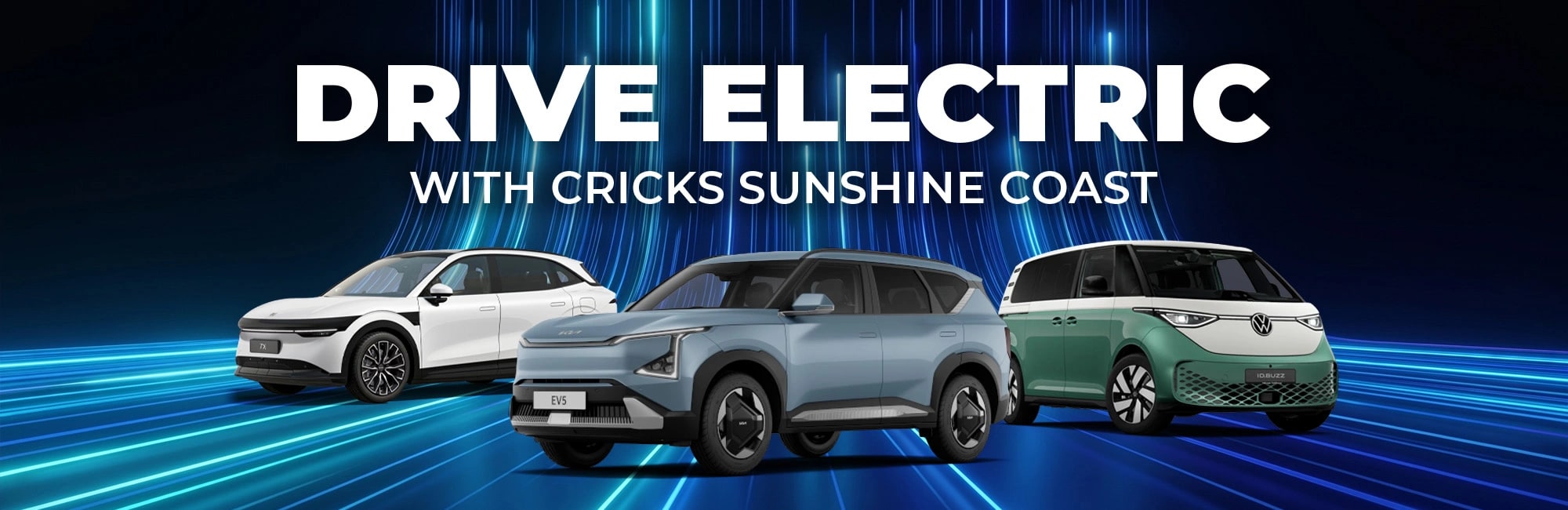
Electric Cars Sunshine Coast
Drive the Future with Cricks Sunshine Coast
Explore the latest electric cars on the Sunshine Coast at Cricks Sunshine Coast. Whether you’re looking for a fully electric vehicle, hybrid, or plug-in hybrid, we offer a range of options designed for smarter, more efficient driving.
With lower running costs, advanced technology, and a smoother driving experience, there’s never been a better time to make the switch to electric.
Browse Our Range
Why Go Electric?
Electric vehicles (EVs) are becoming an increasingly popular choice – and for a good reason. Here’s why more Sunshine Coast drivers are making the switch:
Lower Running & Maintenance Costs
Electric and hybrid vehicles are typically more cost-effective to run. Electricity is often cheaper than fuel – especially if you’re using solar – while fewer moving parts means less servicing and maintenance over time.
Environmental Benefits
- Zero tailpipe emissions from fully electric vehicles
- Reduced greenhouse gas emissions, especially when powered by renewable energy
- Quieter driving, helping reduce noise pollution
Energy Efficiency
EVs are more efficient at converting energy into movement compared to traditional petrol or diesel vehicles. They also support energy independence by utilising renewable energy sources.
A Better Driving Experience
Enjoy instant acceleration, smooth performance, and near-silent driving. Electric vehicles deliver a more refined and responsive experience behind the wheel.
Incentives & Support
Depending on current programs in Queensland, EV owners may benefit from incentives such as rebates, reduced registration costs, or other savings. Always check current government guidelines.
What’s the Difference Between an EV, PHEV, or Hybrid?
Comparison Table: BEV vs. PHEV vs. HEV
| Feature | BEV (Battery Electric Vehicle) | PHEV (Plug-in Hybrid Electric Vehicle) | HEV (Hybrid Electric Vehicle) |
|---|---|---|---|
| Power Source | Fully electric, powered only by a battery | Electric motor + internal combustion engine (ICE) | Electric motor + ICE (self-charging, no plug-in) |
| Fuel Usage | No petrol or diesel, runs only on electricity | Uses electricity first, then petrol/diesel as backup | Runs on petrol/diesel, with electric assist for efficiency |
| Charging Requirement | Requires external charging (home charger or public station) | Requires external charging for electric mode but can run on petrol | No external charging needed, recharges via regenerative braking |
| Electric-Only Range | Typically 300–600 km (varies by model) | Typically 30–100 km before switching to petrol | Minimal (a few km at low speeds) |
| Total Driving Range | Limited to battery capacity; range depends on access to charging stations | Unlimited (combines electric and petrol) | Unlimited (similar to a traditional petrol vehicle) |
| Running Costs | Lower (electricity is cheaper than fuel, especially with home solar) | Moderate (electricity is cheaper, but petrol may still be needed) | Higher than BEVs/PHEVs (relies mainly on petrol) |
| Maintenance Costs | Lowest (fewer moving parts, no oil changes) | Moderate (ICE components still require servicing) | Higher than BEVs (ICE requires maintenance) |
| Environmental Impact | Lowest (zero emissions, ideal for reducing Australia’s carbon footprint) | Moderate (low emissions in electric mode but still uses fuel) | Higher than BEVs/PHEVs (uses petrol most of the time) |
| Performance | Instant torque, smooth & quiet ride | Strong acceleration, but heavier than BEVs | Better fuel efficiency than petrol cars, but lower performance |
| Charging Infrastructure Dependence | High – requires access to home/public charging | Moderate – benefits from charging but can run on petrol | None – behaves like a petrol car with better efficiency |
| Availability of Models in Australia | Growing, but still fewer options than petrol/diesel cars | Limited selection, fewer models available in Australia | Wide variety available from multiple manufacturers |
| Purchase Price | Highest upfront cost (but offset by lower running costs) | Mid-range cost (often more expensive than HEVs but cheaper than BEVs) | Generally the most affordable option |
| Best For | Drivers who can charge at home/work and want zero emissions | Those who want electric benefits but need petrol backup for longer trips | Drivers who want better fuel efficiency without charging concerns |
Charging an Electric Vehicle (EV):
Here is some information that might help
Types of EV Chargers
EV chargers come in different types and speeds, affecting how quickly you can recharge your vehicle:
| Charger Type | Power Rating | Charging Speed | Use Case |
|---|---|---|---|
| Level 1 (Trickle) | 2.4 kW | 8–20 hours for full charge | Standard household outlet (10A) |
| Level 2 (AC Fast) | 7–22 kW | 3–12 hours for full charge | Home chargers, public AC stations |
| DC Fast Charging | 50–150 kW | 30–60 min for 80% charge | Highway charging stations |
| Ultra-Fast Charging | 350 kW | 10–20 min for 80% charge | High-performance EVs, major highways |
Fast Charging vs. Slow Charging
| Charging Type | Pros | Cons |
|---|---|---|
| Slow Charging (AC) | Lower cost, better for battery health | Takes longer, less convenient for road trips |
| Fast Charging (DC) | Quick top-ups, ideal for long trips | More expensive, can increase battery wear over time |
Charge Times vs. Range
The time it takes to charge your EV depends on the charger type and battery size.
| Charger Type | Typical Charge Time (80%) | Estimated Range Added per Hour of Charging |
|---|---|---|
| Level 1 (2.4 kW) | 8–20 hours | ~10 km per hour |
| Level 2 (7–22 kW) | 3–12 hours | ~40–120 km per hour |
| DC Fast (50–150 kW) | 30–60 minutes | ~200–400 km in 30 mins |
| Ultra-Fast (350 kW) | 10–20 minutes | ~300+ km in 10 mins |